Low-Temp Dabbing: A Complete Guide to Flavor-First Sessions

Low-temp dabbing gets recommended constantly and explained badly. The usual version — “stay below the terpene boiling point” — doesn't survive contact with the numbers, because every dab temperature in normal use is already far above every terpene's boiling point. That doesn't mean low-temp is wrong. It means the reason it works is different from what most guides say.
Here's what's actually happening, and how to use it.
What Low-Temp Actually Means
In practice, “low-temp” refers to running the bottom third of a typical e-rig's range — roughly 450–550°F on a device that tops out around 650°F. It doesn't mean cold. It means low relative to the range, and low enough that you're vaporizing your material rather than pushing it toward degradation.
Why the “Boiling Point” Explanation Is Misleading
Terpene boiling points at atmospheric pressure land well below dabbing temperatures — most sit in the 220–390°F range. If staying below them were the goal, no dab temperature would work at all.
Two things resolve the contradiction:
Your set temperature is the chamber temperature, not the material temperature. The number on your screen describes the surface your concentrate is sitting on. The material itself is cooler than that surface, and it climbs while you draw. Heat transfer isn't instant and it isn't uniform.
The real risk isn't boiling — it's degradation. You want the aromatic compounds in your concentrate to vaporize and reach you intact. Push the chamber hot enough and they break down instead, along with everything else in the load. That's what a harsh, flat, slightly burnt hit is: not a boiling-point threshold crossed, but thermal degradation.
So low-temp works because it vaporizes without destroying, and because it lets different compounds come off in sequence rather than all at once.
The Tradeoff You're Actually Making
Every temperature choice trades flavor complexity against vapor density. There's no setting that maximizes both.
How to Dial It In
- Start lower than you think. Begin around 480–500°F and work up in small increments. It's easy to add heat and impossible to recover a load you've scorched.
- Change one variable at a time. Temperature, load size, and draw speed all affect the result. Adjusting all three at once tells you nothing.
- Use a smaller load at low temp. Low temperatures heat a large load unevenly — the bottom vaporizes while the top barely moves.
- Draw slower. A hard, fast pull at low temperature pulls cool air across the material instead of letting it vaporize. Slow and steady is doing real work here, not just ritual.
- Use the carb cap. Restricting airflow keeps heat where it needs to be and gives you control as the load comes up to temperature.
- Expect to re-dial per batch. Different material, different consistency, different window. A setting that was perfect last week may not be right for this jar.
Cold Start: The Technique That Makes Low-Temp Work
Cold start means loading the chamber before turning the heater on, so your material rises through the temperature range with the chamber rather than hitting a hot surface. Because compounds volatilize at different points, that gradual climb is what produces layered flavor instead of a single flat note.
Hot start — heating first, then loading — does the opposite: immediate, dense vaporization with less nuance. Neither is wrong. Cold start is the flavor-first default; hot start is there when you want output.
What Your Hardware Has to Do
Low-temp dabbing asks more of a device than high-temp does, for a simple reason: when you're not overwhelming everything with heat, the chamber's own characteristics stop being masked.
- Precision, not presets. A fixed-preset device may have no setting where you actually want to be. Low-temp work needs a continuous range.
- Temperature stability. Holding a setting matters more than reaching it. Drift mid-draw is what turns a dialed-in session into an inconsistent one.
- A non-porous chamber. At high temperatures, chamber flavor gets buried. At low temperatures it's fully audible — which is why porous ceramic's accumulated residue shows up most in exactly the sessions where you care about flavor most. See why quartz beats ceramic for flavor.
- Airflow control. A carb cap that lets you modulate airflow is doing more at low temp than at high temp.
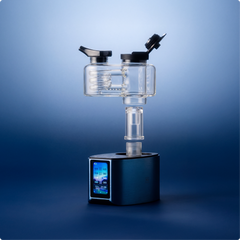
The DaVinci EQ was built around this: a continuous 450–650°F range with four retunable Smart Paths (the lowest sitting at 480–500°F), an all-quartz vapor path that stays flavor-neutral, cold start support, and a zirconia carb cap for airflow control.
Related Reading
- Common Terpenes and Their Boiling Points
- Best E-Rig for Flavor: Why Quartz Beats Ceramic
- Best E-Rig for Rosin: What Actually Matters
- DaVinci EQ Temperature Guide: Best Settings by Concentrate
- How to Clean an E-Rig (and Prevent Chazzing)
FAQ
What temperature counts as a low-temp dab?
Generally the bottom third of a device's range — roughly 450–550°F on a rig topping out near 650°F. It's relative to the device, not an absolute number.
Is low-temp dabbing less wasteful?
Not automatically. Going too low leaves material unvaporized in the chamber, which is its own kind of waste. The efficient window is low enough to avoid degradation but high enough to fully vaporize the load.
Why does my low-temp dab taste like nothing?
Usually too low, too large a load, or too fast a draw. Try a smaller load and a slower pull before raising the temperature — those fix it more often than heat does.
Do I need to stay below terpene boiling points?
No — that's not achievable at dabbing temperatures, and it's not the mechanism. What matters is avoiding thermal degradation and letting compounds come off in sequence.
Does chamber material really matter at low temp?
More than at high temp. High heat masks a chamber's own flavor contribution; low heat doesn't. It's the main reason material choice comes up most in flavor-focused conversations.